Reflections on Plague: A 16th-Century Sermon Series

In 1577, plague hit the mining town of Körmöcbánya, i.e. Kremnica in Upper Hungary (modern-day Slovakia) and killed some 1400 people in total. A few years later, the plague served as the subject of a series of 15 sermons preached to the evangelical miners and other townspeople by David Reussius. He interpreted the plague as a warning and punishment for sin, a test of faith, and a call to repentance and renewed hope of eternal life, and utilized it both to strengthen the Evangelical Protestant identity of his community against Catholicism and to criticize the moral failings of the townspeople. In addition, he offered his flock concrete, practical advice on how to both prevent and treat the illness. The sermons were printed in Leipzig in 1581, and preached again by Reussius in another mining-town, Nagybánya (Baia Mare), in 1586.

Reussius’s sermons serve as a good example of 16th-century thinking about plagues while also providing a potential glimpse of the life in one of late medieval Hungary’s most prestigious towns in the post-Reformation era. In this blog post, I will examine some of the particularly interesting parts of Reussius’s sermons. I draw especially on Katalin Rákóczi’s article “Tizenöt prédikáció a pestisről. David Reuss prédikációs könyve” (Fifteen Sermons on the Plague. David Reuss’s Sermon Book), published in Communicationes de historia artis medicinae in 2004.

Plague’s nature and causes

Reussius 1581, fol. [1v]: King David

The first of Reussius’s sermons establishes the Biblical background to the sermon series, while the following sermons include detailed discussions of the nature, causes, and spiritual and physical remedies of the plague, coupled with both heavy moral admonitions (preaching of the law) and encouragements (preaching of the Gospel). The sermon series is built around scripture, particularly Psalm 91. For example, the third sermon on the plagues’ symptoms is structured around the six names of plague, several of which are taken directly from the psalm:

The six names of plague

1. hunter’s snare (laqueum venantis/venatoris) – the devil hunts for man and rends his body
2. plague of calamity and ruin (pestis calamitatis vel perditionis) – the plague hurts both the individual’s body and the community
3. terror of the night (timor nocturnus) – fear contributes to the disease; witches do their evil under cover of night
4. the arrow that flieth in the day (sagittam volantem in die) and noonday demon (daemonium meridianum) – plague kills quick like an arrow
5. the trouble that walks in darkness (negotium perambulans in tenebris) – the plague’s symptoms include tiredness, melancholy, heaviness of limbs
6. mass mortality – the plague kills many far and wide (Reussius also gives earlier historical examples)

Fol. 34v: beginning of the 4th sermon.

In the next sermon, Reussius discusses the various explanations given to the plague. The “common man”, he says, attributes the plague to travellers, who brought the sickness in their clothes and food and infected gathering places like taverns and bathhouses. The astronomers look to the stars and planets for explanations: Reussius refers to practica and calendars that predicted the coming together of Saturn, Mars, and Jupiter, which was followed by several solar and lunar eclipses. Moreover, cold summers and warm winters cause a humid atmosphere particularly suited to the spread of bad vapours. Doctors, meanwhile, cite the imbalance of humors caused i.a. by the person’s diet.

Reussius rejects none of these explanations, and in fact actively agrees with the “common man’s” interpretation, admonishing the town’s leadership for allowing strangers to infect local houses and people. Reussius emphasises, however, that these are mere secondary causes. The true explanation for plagues is to be found in God’s word, from which Reussius concludes that God sends plagues as punishment for sins.

The rest of the lengthy fourth sermon is devoted to the discussion of the various failings that kindled God’s wrath. These include the ignoring of his previous signs and warnings — Reussius connects the plague to other Wunderzeichen, wonders or prodigies such as celestial apparitions, eclipses, comets, and general natural disorder. These were often interpreted as divine warnings and were widely discussed in European print from the late 15th century onwards.

Reussius was most probably familiar with both the numerous broadsheets and pamphlets and the longer treatises and collections of wonders that appeared in Germany throughout the 16th century. In fact, later in the same sermon he refers directly to one such collection on comets and other wonders (including plagues) published by Sigismund Suevus in 1578. He also lists some recent signs in the year 1580: two comets and the appearance of multiple suns (parelia), which Reussius sees as certainly having some great meaning.

Multiple suns and moons, depicted in Conrad Lycosthenes’ Prodigiorum ac ostentorum chronicon (1557), p. 612.

In light of the above interpretation of plagues, the principle remedy Reussius presents is a spiritual one. The plague and the various Wunderzeichen of the times served as calls to repent and reconcile with God before it would be too late. To the faithful, it presented an opportunity to meditate on their mortality, strengthen their faith through trial, grow in virtue, and renew their yearning for eternal life in Heaven free from temporal sufferings.

Preaching in the mining town of Kremnica

Much of the material in Reussius’ sermons is generally applicable, which made them good material for printing. They were, however, composed for a specific audience, the German-speaking Evangelical miners and other townspeople in Kremnica. Reussius made sure to tailor his preaching for this audience in both content and expression. According to Rákóczi’s analysis, Reussius kept himself to simple and colloquial language, enriched by repetition, generous use of adjectives, alliteration, etc. In the text, Reussius also acknowledges the views and life situation of the “common man”. For example, he notes that his listeners are not able to frequent expensive pharmacies, and thus recommends ordinary healing plants and herbs found in their yards and fields. He also encourages the miners of the town to continue work even during times of plague, though with certain precautions.

Furthermore, the moral admonitions closely linked to the theological interpretation of plagues are in the sermons directed specifically to the townspeople of Kremnica. Reussius admonishes the townspeople especially for their presumption and vanity. He is particularly concerned about burghers and even the poorer people of the town dressing above their station in expensive fabrics and noble fashions, thus eroding the hierarchies of the community and breaking traditional norms even while attending church. He also critiques the general lavish lifestyle and disregard for the poor by many of the town’s wealthier magistrates.

As Rákóczi notes, it is difficult to know to what extent Reussius’ descriptions were warranted, but it is not unreasonable to assume that the traditionally wealthy gold mining and minting town, despite recent hardships, might have allowed its inhabitants a more relaxed and luxurious lifestyle than was possible in less prosperous towns. Kremnica had become the leading mining town of Hungary in the 14th century, when King Charles I’s reforms led to the opening of new gold mines and the founding of the royal mint.

King Matthias Corvinus’s (1458-1490) gold forint, minted in Kremnica (Wikimedia)

According to Reussius, everyone wanted the best of houses, causing the construction of many “unnecessary buildings” – possibly this is connected to the rebuilding projects in the town following a large-scale fire in 1560. Cheating and usurious merchants and money-lenders are denounced with even harsher words, and Reussius takes the time to cite the acceptable rates of interest as defined in Imperial law.

Plague, crisis, and confessional identity

Medieval and early modern plagues and other natural disasters were communal crises that were often closely linked to social and religious struggles. In his book Strategies of Sanity and Survival: Religious Responses to Natural Disasters in the Middle Ages (2002), Jussi Hanska discusses the various responses to such upheavals, focusing especially on sermon material. Medieval catastrophe sermons, like Reussius’s 16th-century plague sermon series, generally viewed these disasters as divine punishment for both general and local sins, but could also utilize them to attack specific groups: Jews, Muslims, Christian heretics, and (towards the end of the Middle Ages) witches were blamed for the misfortunes of the community. Reussius, too, connects the evil nightly deeds of witches and the appearance of wandering healers with plagues, while making disparaging comments about Jews and making sure to denounce the heresies of Rome.

While Reussius utilized the plague to criticize his parishioners for their sins and calling them to repent, he also used it to attack religious others and drew on the community’s experience of plague to build a stronger confessional identity among Kremnica’s Lutherans. According to Rákóczi, Reussius’ principal aim with the sermon series was to demonstrate that their faithfulness and piety even under the pressures posed by the Counter-Reformation were the reason why God’s mercy prevailed and the plague subsided. Were it not for the steadfast faith of the Lutheran populace, the town might have suffered from the plague much longer.

Physical precautions and remedies

Since plague was first and foremost sent by God, Reussius states that it is useless to try to flee misfortune by leaving the town. Nevertheless, there were several practical measures besides prayer and repentance that could be taken to prevent or treat the illness – these are the subject of Reussius’s sixth sermon.

Some of the advice sounds rather familiar to us after more than a year of the COVID-19 pandemic. Reussius instructs his listeners to avoid places where people congregate, such as markets and banquets, though makes an exception for weddings, which need not be postponed. To protect children, schools must be closed. The ill must be isolated from the healthy and be taken care of at home. When going outside, one should keep a cloth soaked in a herb decoction in front of their nose. Upon coming home, hands must be washed with vinegar. It is also important to keep up good spirits, avoiding fear, sadness, anger, and impatience, since these weaken the person and leave them vulnerable to falling ill. And despite everything, miners and magistrates alike should make sure to fulfill their duties and continue their work.

COVID-19 infographic, detail (Wikimedia)

Reussius does not oppose visiting a doctor if necessary, though admonishes those that do so while neglecting prayer and repentance, and also warns against consulting wandering ‘pharmaci’. Most of the advice he gives is rooted in medical theories of the time: bad humours and poisons should be purged from the body e.g. by bleeding, health is preserved by a moderate and sober lifestyle, and aromatic plants and herbs (like bay leaf, white wormwood, or sage) should be burned to purify the air in homes. When ill, heavy foods should be avoided, instead drinking brews and teas.


Of Reussius’ subsequent sermons in the series, many focus further on the themes of sin, repentance, and consolation. With the coming of Advent, Reussius turns his attention to the second coming of Christ and apocalyptic imagery in the Bible (12th sermon). The second-to-last sermon deals with death, and in the final sermon Reussius focuses on the glory of God and thanksgiving. Overall, the sermon series serves as a good example of 16th-century Lutheran thinking on plague, while also showcasing how early modern medical knowledge was popularised and shared by preachers as part of their sermons.

Sources and Literature

Reussius, David. 1581. Funffzehen kurtze und Einfeltige, doch schöne Lehrhaffte und Trostreiche Predigten … von der
hochschedlichen Seuche der Pestilenz
. Leipzig: Johann Beyer. http://digital.slub-dresden.de/id486833380

* * *

Hanska, Jussi. 2002. Strategies of Sanity and Survival: Religious Responses to Natural Disasters in the Middle Ages. Studia Fennica Historica; 2. Helsinki: Finnish Literature Society.

Rákóczi, Katalin. 2004. “Tizenöt prédikáció a pestisről. David Reuss prédikációs könyve” (Fifteen sermons on the plague. David Reuss’s sermon book). Communicationes de historia artis medicinae 186-187, pp. 63-76. https://library.hungaricana.hu/en/view/ORSZ_ORVO_OK_2004_186_187/

Tóth, G. Peter. 2009. “Tárgyak, férgek, démonok. Társadalmi válságtünetek és demonológiai diagnózisok a kora újkori Magyarországon” (Objects, vermin, demons. Symptoms of social crisis and demonological diagnoses in early modern Hungary). Korall 35, pp. 5-42. http://epa.oszk.hu/00400/00414/00026/pdf/korall_35_005-042.pdf

Animal highlights from Ostia, Gateway to Rome

I recently got to visit Tampere again to see the exhibition on the Roman harbour city of Ostia, the subject of the research project “Segregated or Integrated? Living and Dying in the harbour city of Ostia, 300 BCE – 700 CE”.
The exhibition provided a wonderfully varied look at life in classical Ostia, touching on everything from trade and governing to entertainment, family life, medicine, religion, and death — all without being too unwieldy to appreciate in the space of one afternoon visit to the museum. There was no shortage of interesting artefacts to look at, the accompanying texts were informative, and technology was used in a supportive role, not taking away attention from the objects on display. Overall, I really enjoyed the exhibition, and can recommend visiting it (as long as the pandemic situation continues to allow it) before January 10th, 2021, when it’s set to end.

Instead of giving an overview of the exhibition (which is much better experienced in person), I thought I’d collect some animal-related highlights below. Since being introduced to Kathleen Walker-Meikle’s work, I’ve tried to pay attention to animal history whenever there’s been an opportunity, and animals were frequently depicted in the objects from Ostia. I was also inspired to take a look at two books on animal history in antiquity, and have appended some relevant/interesting notes therefrom.

Continue reading “Animal highlights from Ostia, Gateway to Rome”

Diagrams in Isidore of Seville’s De natura rerum

A year ago I had the opportunity to audit the sixty-seventh Settimana di studi in Spoleto, a week-long seminar on early medieval scientific thinking. I’m now brushing up on my notes and some additional literature to avoid forgetting what I learned.

Despite endless attempts at debunking the idea of the medieval period as the “Dark Ages”, it keeps popping up — if not in reference to the entire Middle Ages (with its numerous “renaissances”), at least to its earliest centuries in Western Europe. These centuries are associated with political and economic upheavals, a significant loss of classical texts, and a general disarray which would’ve limited cultural and scientific activity.

Scholars of the Early Middle Ages have rightly emphasized the numerous continuities between late antiquity and the first medieval centuries. The common picture of a sudden, total collapse in the west is misleading, and the early medieval period was devoid neither of cultural activity nor a keen interest in classical learning. At the same time it’s undeniable that early medieval authors had much more limited access to classical writings than either their predecessors or their post-12th-century successors, and that this affected their literary output.

The above is reflected in the works of Isidore of Seville, who laboured in early-7th-century Spain to bring together ancient and Christian knowledge. He is best known for his Etymologies, but authored a number of other interesting works, among them an introductory work or schoolbook known as De natura rerum (On the nature of things). It combined the study of time with cosmography and meteorology to provide a general overview of the natural world. Notably, it is not structured according to the creation story of the Book of Genesis, as was typical of Christian treatments of the natural world, but rather follows the example of classical introductions to the subject. Isidore had limited access to these works but managed to combine information from various sources, including commentaries and Christian authors. While De natura rerum as a whole is decidedly Christian (and includes some wonderful allegorical interpretations of natural phenomena), Isidore cites Greek science, Roman poetry, Biblical examples and Christian authorities equally.

The Book of Wheels

De natura rerum was often called Liber rotarum after its distinctive rotae, the circular figures or diagrams. These impressive illustrations are found in numerous manuscripts as well as the earliest printed editions. The manuscripts vary in the form and number of these diagrams, but it seems clear that Isidore himself included some seven of them himself, since several diagrams are explicitly referred to in the text and appear quite consistently across the earliest manuscripts.

The diagrams used by Isidore achieved huge popularity in the Middle Ages. Scholars have been somewhat divergent in how they’ve interpreted medieval diagrams: some have emphasized their classical roots and scientific contents, others the Christian symbolism (e.g. the image of the cross) fused therewith. The fact that medieval diagrams were imbued with Christian symbols shows that while the diagrams were in fact based on classical models, they were not simply copied, but changed to fit a new, Christian view of the world (Wallis 2015).

As De natura rerum was copied and disseminated, so were (much of the time) the diagrams, and as they were copied they underwent different kinds of alterations. Below, I’ll discuss the most common diagrams in chronological order and go through some examples I found of differences between different manuscripts.

Diagrams of time

De natura rerum begins with a discussion of time, starting with the day, night, and week. The first diagram appears in chapter 4 on the months. Isidore explains that the period of the month is based on the cycle of the moon from new moon to new moon. The Hebrew calendar keeps to this (as it does to this day), while the Roman calendar used variable months, and Egyptians months of 30 days each.

The diagram is made up of concentric rings divided into twelve segments and serves as a circular reference table or concordance wheel for the Roman and Egyptian months (Kendall/Wallis 2016, p. 184). The dates for the beginning of the Egyptian months are given in terms of the Roman months: e.g. the segment for July has the note VII k.l. = the Egyptian month begins on the 7th calends of July, i.e. seven days (if you include July 1!) before the beginning of July.

Diagram 1, BSB Clm 14300, fol. 3v. 8th century.

The length of the months are given according to the Egyptian calendar (30 days for all months) in most manuscripts, but a couple give varying lengths for different months.

Diagram 1, St Gall, SB 238, p. 325. 760-780. Detail showing the upper half of the diagram: January and May have 31 days, February 28.

The Roman names for the months are repeated twice in some versions of the diagram — maybe it was originally meant to include the Egyptian names for the month as well (Kendall/Wallis 2016, p. 184), which would make sense, but doesn’t appear in any of the extant manuscripts. Instead, some manuscripts give the full name and the abbreviated names of the months separately. Others do away with the superfluous row in the circle and only give the name of the month once.

The second diagram illustrates the chapter on seasons (or literally “times”, De temporibus) and depicts the four seasons of the year according to their qualities (combinations of hot, cold, moist, dry) and cardinal directions. Winter (north) is cold and humid, spring (east) humid and warm, summer (south) warm and dry, and autumn (west) dry and cold. The connections and oppositions of the qualities and seasons are neatly illustrated with a circle divided by 4 + 4 arcs (qualities + seasons).

Diagram 2, BSB Clm 14300, fol. 5v. 8th cent.

In one of the manuscripts I looked at, the number of arcs dividing the circle are increased (to 12 total) to form a star- or sun-like pattern. The shape of a cross is also added to the middle circle, an example of introducing Christian iconography to diagrams.

Diagram 2, BSB-Hss Clm 396, fol. 9v. 9th cent.

In a slightly earlier manuscript the arcs are reduced to 4 (the seasons), and a cross is used to separate the qualities:

Diagram 2, Erzbischöfliche Diözesan- und Dombibliothek 99, fol. 59v. c. 800.

The five zones or circles of the world

Following time, Isidore discusses cosmology, the structure of the world. The third diagram depicts the five “circles of the world”, arranged like the petals of a flower (Stevens 1980, p. 274). The five circles set around a smaller circle represent the different climatic zones of the Earth: the northern- and southernmost circles as well as the middle circle are denoted as inhabitable, while the second and fourth circles are the habitable zones.

Diagram 3, BSB Clm 14300, fol. 6v. 8th cent.

This is the typical classical and medieval understanding of the five zones of the Earth, though the diagram is unusual. A more typical image would depict the globe of the Earth as a circle divided into five parts by horizontal lines.

Berlin, Staatsbibliothek, Ms. Phill. 1833, fol. 39v. 10th century. Abbo of Fleury’s map of the world based on Macrobius. Source: Wikimedia.

In the text Isidore further illustrates the five zones by explaining that the zones can be visualised by imagining one’s right hand. Each finger represents one zone: the thumb and little finger the cold zones, the middle finger the hot zone, and the second and fourth fingers the temperate, habitable zones. The varying lengths of the fingers even work out to mimic the curvature of a circle/globe, with the middle zone being the longest. This kind of mental visual material was an alternative approach to illustrating scientific knowledge, which some medieval authors preferred to diagrammatic visualisations – Isidore clearly feels comfortable utilizing both.

But why is the diagram so different from conventional climatic zone depictions? It’s possible that Isidore and/or the author of the diagram visualized the fingers as being spread, not kept together, and the five circles in the diagram were meant to mirror an open hand with fingers (circles) spread out. The strange arrangement of the circles could also have been meant to illustrate the similarity of the northern and southern arctic climate zones by bringing them close together (Kendall/Wallis 2016, pp. 195-6). The second and fourth zones, however, are this way separated.

In one 8th-century manuscript the flower-petal arrangement is done away with, and the diagram is simplified to five circles side-by-side, with no textual elements explaining the figure. Most manuscripts seem to keep to the flower-like shape, however, and mainly vary on whether they make note of e.g. cardinal directions outside the circles.

Diagram 3, St Gall, SB 238, p. 335. 760-780.

The strange diagram of the elements

Isidore’s fourth diagram depicting the four elements is undoubtedly the oddest. It stands out from the circular diagrams: it’s made up of two overlapping rectangles divided into triangles by diagonal lines, creating what seems to be intended as a three-dimensional figure:

Diagram 4, BSB Clm 14300, fol. 7v. 8th cent.

The purpose of the diagram is to illustrate the shared and distinct properties of each of the four elements. These properties are from Plato: fire is thin, sharp, and mobile; air is thick, sharp, and mobile; earth is thick, blunt, and immobile; and water is thick, blunt, and mobile. The sides of the triangles in the diagram represent the three properties of each element. Fire and earth are opposing elements, sharing no properties, while air and water share their properties with fire and earth. Water has more affinity with earth, sharing two properties, and air likewise is closer to fire.

This diagram has been much discussed, i.a. by Bruce Eastwood (Eastwood 2001). Scholars disagree on whether this diagram was Isidore’s own design or whether it originated from the commentary tradition of Plato’s Timaeus (Kendall/Wallis 2016, p. 198ff). In either case, the diagram is a bit of a puzzle for the modern reader, and probably to many medieval scribes as well – this diagram varies a lot across manuscripts.

Eastwood (2001) categorized the early copies of the diagram into four groups according to how closely they kept to the original three-dimensional arrangement. Several manuscripts simplify and abstract the diagram, losing the three-dimensional quality but usually retaining the rectangular and triangular shapes. The circles above and below the rectangles are sometimes labelled as sun and moon, sometimes omitted entirely. The decorative elements of the diagram also vary a lot.

In some manuscripts the diagram is turned into a rota to match the rest of the diagrams. In the above, 11th-century Bodleian library manuscript the elements are arranged inside a circle resembling the structure of the world: the fiery high heavens are followed by the mediating elements of air and water, and finally earth. In a similarly later, 12th-century manuscript the elements are placed inside a circle as well:

Diagram 4, Einsiedeln SB 360, fol. 38v. 12th cent.

A circular version of the diagram is also used in the first printed edition of the work, while in the two 16th-century editions include simplified square diagrams. Both of these square diagrams diverge somewhat from the original: the 1580 edition removes the overlap between the squares, distancing earth and water from fire and air, while the 1599 places earth closer to air than to water, contradictory to their shared properties.

The wheel of the elements / microcosm

Isidore’s chapter on the elements includes a second diagram. This fifth diagram of De natura rerum returns to the familiar circular shape, this time illustrating the elements according to their qualities of hot, cold, moist, and dry (fire is dry and hot, air hot and moist, water moist and cold, earth cold and dry). Since now each element is associated with two instead of three qualities, a circular diagram akin to the one of the seasons is easy to produce:

Diagram 5, BSB Clm 14300, fol. 8r. 8th cent.

There’s much less variation across the manuscripts in this case. The diagram depicts not only the elements of the world, but also the seasons and the humours, calling to mind the concept of man as “microcosmos” introduced by Isidore in an earlier chapter.

Planets and winds

Isidore’s sixth diagram continues on the theme of cosmography and depicts the order of the seven planets (the Moon, Mercury, “Lucifer” i.e. Venus, the Sun, “Vesper” i.e. Mars, “Phaëton” i.e. Jupiter, and Saturn) orbiting the Earth.

Diagram 6, BSB Clm 14300, fol. 14r. 8th cent.

The diagram itself is quite common. But Isidore also includes the number of years for each planet to complete its course, and these are weird – only Jupiter and Saturn are correct, but for the rest the numbers are very much off, some in ways that should be obvious to Isidore. The moon is stated to take 8 years, the sun 19 years to complete its course, instead of a month and a year respectively – why? Possibly these numbers echoed the eight- and nineteen-year luni-solar cycles used to plot the phases of the moon on a solar calendar in order to predict the date of Easter (Kendall/Wallis 2016, pp. 223-24). This doesn’t explain the other erroneous numbers, however.

After discussing cosmography, Isidore moves on to meteorology, i.e. atmospheric phenomena, which in antiquity and the Middle Ages were understood to include such things as comets, earthquakes, waters, volcanoes, etc. One chapter on winds includes what is referred to as the seventh diagram of De natura rerum, depicting 12 winds with their names and directions.

Diagram 7, BSB Clm 14300, fol. 18v. 8th cent.

There are reasons to believe that this diagram was not originally included by Isidore (it’s the only diagram in this part of the work, it’s not introduced in the original text, and there are some discrepancies between the text and the diagram) – despite this, it apparently appears in most manuscripts (Kendall/Wallis 2016, 236-37). It’s omitted, however, in many of the manuscripts I’ve looked through.

The phases of the moon, and further diagrams

There’s one further illustration, however, which does appear to have been placed in the work by Isidore (it is referred to in the text). Numbered diagram 5A in the 2016 edition, it depicts the seven phases of the moon. It’s not always included in manuscript copies and does not appear in the early printed editions. Some manuscripts relegate the pictures of the moon to the margins:

Diagram 5A, BSB Clm 14300, fol. 12r. 8th cent.

While in others the diagram is given a more prominent place on the page:

Diagram 5A, BSB-Hss Clm 396, fol. 18v. 9th cent.

Different manuscript copies add various further diagrams to the text, including a T-O-map, the rainbow, and (strange as it seems) the mountains of Sicily. The above 9th-century manuscript BSB Clm 396 in particular has numerous extra circular diagrams throughout De natura rerum.

Alternatively, diagrams could be omitted from copies partially or entirely. Sometimes there was the intention of adding them in, but all we’re left with are blank spaces:

Universitätsbibliothek Basel F III 15f, fol. 4v. 8th century. Spaces left for the diagrams are noted with “Locus Figura”.

Sometimes scribes were working based on an exemplar without illustrations and had to turn to a different exemplar for the diagrams. Differences in the diagrams in different copies could also be introduced because the copyist was not skilled enough to reproduce the image, or, conversely, because they thought they could improve on the exemplar by changing the diagram (Eastwood 2001). Moreover, depending on the manuscripts, scribes had different layouts and amounts of page space (and scribal time) to work with. Diagrams served the role of visually conveying information, but they could also be included for their decorative value. Several of the rotae added to BSB Clm 396, for example, offer very little content-wise, but serve to make the work more pleasing to the eye and highlighting different sections in the text:


Manuscripts:

St Gall, SB 238 = St Gall, Stiftsbibliothek, Cod. Sang. 238. (760-780, St Gall.)

Universitätsbibliothek Basel F III 15f = Basel, Universitätsbibliothek, F III 15f. (8th century, England.)

BSB Clm 14300 = Munich, Bayerische Staatsbibliothek, Clm 14300. (8th century, Salzburg.)

Erzbischöfliche Diözesan- und Dombibliothek 99 = Cologne, Erzbischöfliche Diözesan- und Dombibliothek, Cod. 99. (c. 800, Cologne?)

BSB-Hss Clm 396 = Munich, Bayerische Staatsbibliothek, Clm 396. (9th century, Brittany or Wales.)

Bodleian Library MS. Auct. F. 2. 20 = Oxford, Bodleian Library, MS. Auct. F. 2. 20. (11th century, England.)

Einsiedeln SB 360 = Einsiedeln, Stiftsbibliothek, Cod. 360. (12th century, Engleberg.)

Printed sources online:

Günther Zainer’s edition, pr. Augsburg 1472: Library of Congress.

Margerin de la Bigne’s edition, in Isidore’s Opera omnia, pr. Paris 1580: Bayerische Staatsbibliothek.

Juan Grial’s edition, in Isidore’s Opera omnia, pr. Madrid 1599: Google Books.

Editions & Literature:

Eastwood, Bruce. 2001. ‘The Diagram of the Four Elements in the Oldest Manuscripts of Isidore’s “De Natura Rerum”’. Studi Medievali 42: 547–70.

Kendall, Calvin B., and Faith Wallis, eds. 2016. On the Nature of Things. Translated Texts for Historians 66. Liverpool: Liverpool University Press.

Stevens, Wesley M. 1980. ‘The Figure of the Earth in Isidore’s “De Natura Rerum”’. Isis 71: 268–77.

Wallis, Faith. 2015. ‘What a Medieval Diagram Shows: A Case Study of “Computus”’. Studies in Iconography 36: 1–40.

Maximilian I, Holy Roman Emperor, d. 1519

Today marks the 500 year anniversary of the Maximilian I’s death on January 12, 1519. Maximilian I lived in a fascinating time: the proliferation of the printing press, the discovery of the New World and the beginnings of the Reformation are some of the most famous markers of the turn of the 15th and 16th centuries.

Maximilian was the first among rulers to utilize the potential of printing technology in the service of government, choosing to issue many proclamations and instructions in printed instead of manuscript form (Pettegree 2017, p. 17). Accounts of Maximilian’s life leave an impression of an energetic and ambitious man. He was keen to portray himself as both a practitioner and a patron of the arts and sciences, and forged many useful connections with various scholars of his time, including astrologers like Joseph Grünpeck (astrologers were a common sight in late medieval and early modern courts, but Maximilian distinguished himself in drawing especial attention to his use of astrological advisers). Printing presses were put to work as laudatory works by humanists appeared in support of Maximilian throughout his reign, first as King of the Romans and later as Emperor (Fichtner 1996, Hayton 2015, Pettegree 2014).

One of these humanists was Sebastian Brant. A Basel-based lawyer and teacher of Latin and poetics, Brant turned his skills to the service of Maximilian in various printed broadsheets. According to Falk Eisermann (2003) Brant was the one to popularize what would become the characteristic Flugblatt in 1492 with his poems, accompanied by a woodcut and published as a single-sheet print (broadside), describing and interpreting the thunderstone (meteorite) that had fallen near Ensisheim towards the end of that year. Brant declared that the stone had been sent by God to Maximilian as a divine show of support and sign of Maximilian’s coming victory in his conflict against the French.

Maximilian’s victory at Salins in 1493 vindicated Brant, as he was quick to point out in his celebratory poem of the event, published again in broadside form. The meteorite was later again utilized by Brant after the death of Maximilian’s father – this time the stone was used to lend support to Maximilian’s calls for a crusade against the Turkish forces threatening Europe at the time. This project, however, ultimately failed to get off the ground. (On Sebastian Brant and the Ensisheim meteorite see e.g. Marvin 1992.)

Many of Maximilian’s ventures ultimately failed to bear fruit. Peace and order were difficult to keep in an Empire rife with internal divisions – his attempts to end the Flemish revolts, for example, led to his imprisonment in the city of Bruges in 1488, a humiliating ordeal (Pettegree 2014, p. 76). Many of his political initiatives didn’t fulfill his hopes, though some, like the Reichskammergericht, came to be important (Fichtner 1996).

Maximilian I’s Death

As an emperor keenly interested in his public image, Maximilian had to think ahead also to his death. Already in 1506 he had made a payment (for Konrad Peutinger and Joseph Grünpeck) for work done on his tomb (Hayton 2015, p. 223 n. 94). In the years leading up to his death, Maximilian apparently always traveled with his coffin. He had also given specific – and to the modern reader, singularly strange – instructions for the treatment of his body after death: his hair was to be cut off, his teeth knocked out, and his body covered in lime and ash, whipped, wrapped and covered with layers of coarse linen, fine linen, white silk and damask, and publicly displayed before being buried without crown or scepter . All this “to show the perishableness of all earthly glory” (Weiss-Krejci 2008, p. 186 / Schmid 1997, p. 203).

Maximilian spent his last weeks ill in Wels, Upper Austria until he died there on January 12, 1519. When his astrologer and secretary Joseph Grünpeck heard of the emperor’s condition, he rushed to Wels to accompany him. Georg Tannstetter, another astrologer and Maximilian’s physician, was also summoned to Wels, where he stood by Maximilian’s deathbed in the emperor’s final moments (Hayton 2015).

It was in Wels that Maximilian drew up his last will on December 30, 1518. He arranged for regular masses (chantries) to be sung for his soul. He also set aside funds for charitable works, including the founding of eight hospitals for the poor (Benecke 1979, p. 34). (For medieval and early modern preparations for death in general see for example Anu Lahtinen and Mia Korpiola (eds.), Dying Prepared in Medieval and Early Modern Northern Europe, Leiden/Boston: Brill, 2018, and ibid., Planning for death: Wills and death-related property arrangements in Europe, 1200-1600, Leiden/Boston: Brill 2018.)

Maximilian was buried at Wiener Neustadt. Archaeological evidence seems to confirm that at least several of his wishes for the posthumous treatment of his body were granted (Weiss-Krejci 2008, p 186.). The lavish tomb at the Hofkirche of Innsbruck, which was still worked on until 1583, thus remained empty, though it still serves as an impressive monument for Maximilian I.

Sepulchral monument for Maximilian I at Innsbruck.
Literature

Kathleen Walker-Meikle: Medieval Pets (Woodbridge, 2012)

After a busy autumn I was ready to spend my holidays sleeping, eating, and sleeping more, but I did set one book aside for holiday reading, Medieval Pets by Kathleen Walker-Meikle. It proved to be a quick read, a light introduction utilizing a wide variety of sources, including medieval romances, manuscript illuminations and marginalia, hagiographies, letters, and legislative texts. The focus of the book is on the nobility of later medieval Europe with occasional forays into the early modern period.

Medieval Pets is light on theory and large-scale interpretation, but makes interesting observations regarding the social significance and connotations of pets as status symbols and markers of a certain identity: wealthy pet-owners could buy lavish collars, cages and other accessories for their animal companions, and small lap dogs, for example, were associated with women and scholars. Pets were the topic of renaissance letters and elegies and could receive lavish funerals. Exotic animals could serve as impressive gifts between royals or nobility. Animals also had symbolic functions, and it’s not always easy to distinguish in some of the sources between symbolic use or literary topos and actual pet-ownership and emotional attachment to an animal (see for example p. 100).

Walker-Meikle approaches her topic very much with modern pet-keeping in mind. There was no medieval term comparable to the modern English word “pet”, Walker-Meikle notes (p. 1), but she’s interested in animals that served as companions, animals that were kept indoors, named and fed, and were not primarily used for working or hunting. Joyce E. Salisbury notes in her review of this work the difficulties of defining “pet” in a medieval context. The indoor-outdoor distinction is not clear-cut: hunting dogs were not strictly outdoor animals; rural families could share their indoor spaces with their livestock. The line between companion animals and utility animals can be similarly blurred: Walker-Meikle herself mentions the utility of cats as mousers (p. 10).

I initially found Medieval Pets when looking for mentions of monkeys as pets in the middle ages. The book’s strenght in my opinion lies in its varied collection of anecdotes related to (mostly) companion animals in the medieval and early modern period. As such it seems like a good jumping-off point for deeper reading about the topic in general and the mentioned cases in particular. As I read I marked some eye-catching passages, which I’ll note down below, as well as my highlights from the book’s bibliography.

To notes

Konferenssipohdintoja: monikulttuurinen menneisyys

(Conference Musings: the Multicultural Past. Writing in Finnish for a change. The blog is officially going bilingual! Some (very) brief thoughts on the conference in English at the end of this post.)

Seitsemäs Passages From Antiquity to the Middle Ages -konferenssi järjestettiin tänä vuonna otsikolla “Neighbours or Strangers? Conflict, Negotiation, and Collaboration in Multicultural Communities”. Tämä herätti oitis mielenkiintoni. Kulttuurien väliset kohtaamiset ja monikulttuurisuus ovat paljonpuhuttuja ja ajankohtaisia aiheita. Vaikka samansuuntaisia teemoja oli tullut aiemminkin vastaan myös keskiajan tutkimuksessa (ensimmäisenä yliopistovuotenani Robert Bartlettin The Making of Europe:n muodossa, sen jälkeen erityisesti ristiretkiaiheisilla kursseilla), koin, etten ollut aiemmin pysähtynyt sitä pohtimaan. Passages vaikutti hyvältä tilaisuudelta niin tehdä. Se oli myös ensimmäinen auditoimani konferenssi, joka ei rajoittunut ainoastaan keskiaikaan, vaan kattoi myös antiikin tutkimuksen – erinomainen tilaisuus kurkistaa vähän mukavuusalueeni ulkopuolelle.

Vaikka ikävästi ajoittunut flunssa nakersi jossain määrin konferenssi-iloa, oli Passages erittäin antoisa kokemus. Jään aina vähän ihmettelemään miksen useammin törmää konferensseissa perustutkinto-opiskelijoihin, sillä ne ovat joka kerta olleet harvinaisen hauskoja ja valaisevia katsauksia siihen, mitä historiantutkimuksessa parhaillaan tapahtuu. (Tosin tässä tapauksessa konferenssin maksullisuus saattaa selittää osallistumiskynnystä. Onneksi perustutkinto-opiskelijoille maksuttomiakin konferensseja löytyy, seuraavaksi Turun Christianity and Politics -konferenssi!) Monipuoliset esitelmät ja luennot antavat paljon hyvää pohdittavaa, ja parhaimmillaan ne myös auttavat hiomaan oman kiinnostuksen ja opiskelun suuntaamista. Esimerkiksi tämä konferenssi vahvisti tuntemustani siitä, että ”monikulttuuriseen menneisyyteen” olisi hyvä perehtyä.

Continue reading “Konferenssipohdintoja: monikulttuurinen menneisyys”

On the Definition of Miracles

I first became interested in medieval accounts of extraordinary natural phenomena — natural disasters such as earthquakes and droughts, but also sightings of comets, meteorites etc. — when reading Jussi Hanska’s Strategies of Sanity and Survival: Religious Responses to Natural Disasters in the Middle Ages (2002). Hanska describes various ways medieval communities responded to nature-born hardships. He also devotes a chapter to “the aftermath” and the explanations — political, scientific, apocalyptic, and divine — medievals gave the natural disasters that harrowed them.

turkey1
The Basel earthquake of 1356. Illustration in Sebastian Münster’s Cosmographia (mid-16th c.).

Hanska’s book, which I read shortly before entering university, was my primary gateway both to the study of environmental history and to medieval mentalities, and as such has been one of the most formative works I’ve yet to read. My thesis topic, though ultimately not about a medieval natural disaster per se, in many ways drew its initial inspiration from Hanska’s work, and brought me to some of the same questions regarding the medieval understanding of events now termed “natural” but against the usual, day-to-day course of nature. One of those being, how did medieval authors explain these phenomena — did they employ explanations we would term “natural” or even “scientific”, or were these events primarily understood in a purely religious, “supernatural” context?

Today, we have a pretty clear intuition of what constitutes as “natural” as opposed to “supernatural”. Such clear intuitions pose a danger to a historian. One of the first things one must realise when studying this kind of topic is that, first of all, medieval authors may have lacked the very concepts that are central to our research questions today — such is the case for the term natural disaster, which only starts emerging in the 18th century[1] –, and, second of all, even shared terminology may not have had the same meaning then as it does now — this is where the trouble with “natural” and its opposites starts.

In my initial draft of my BA thesis I attempted a very succinct definition of the concepts of “scientific” and “religious” (my initial way of approaching the natural–supernatural-division) by means of defining “scientific” explanations as those that “referred to models of the natural order” (i.e. explanations that sought to incorporate the events in a broader understanding of how nature “works”), and “religious” explanations as those that attributed the event directly to God. After I failed to submit this initial thesis draft and fell into the dreaded trap of discovering new heaps of relevant research literature, I’m faced with the task of elaborating a little on this distinction.

Continue reading “On the Definition of Miracles”

Matthew Holmes doesn’t have a Wikipedia page (pt. 2)

(Link to pt. 1: Grimstock and the Matthew Holmes Lute Books)

Who was Matthew Holmes? The man wrote down four volumes of lute tabulature alone, and five more for other instruments, giving us a marvellous view of late 16th–early 17th century music in England. But scribes seldom labour hours on end just to pass down ordinary tunes of their time to far-off music historians and lute enthusiasts.

musica mentis medicina maestae
Musica mentis medicina maestae” — music is medicine for a sad mind. In Holmes’ hand on the first flyleaf of MS Dd.2.11.

The purpose of Holmes’ work is indeed not entirely clear, but they (excepting his consort books[1]) seem to have been for his own private use, a collection of music Holmes came into contact with and possibly incorporated into his own playing repertory. Matthew Holmes was a professional musician — precentor and singingman, first of Christ Church in Oxford (from the year 1588) and then in Westminster Abbey, London (from 1597 until his death in 1621) –, and was, based on the quality of the pieces he copied, also skilled at playing the lute in his free time. He seems to have been copying music at some speed, or at least with relatively little organisation, copying pieces one after another without sections or blank folios left for later additions, and often copying the same piece several times (though Craig-McFeely suggests that this may well have been deliberate — see Craig-McFeely 2000, p. 176).

With the exception of some small additions and individual passages the books are written in just Holmes’ hand. The quality of his script deteriorated over time — this, combined with an increase of abbreviations and fewer annotations (such as titles), seems to indicate that Holmes’ work, like many of its kind, started somewhat more diligently than it ended, function taking over form as far as the writer’s priorities were concerned.

Dd.2.11 f. 8r
Example from the first of the four lute music manuscripts (MS Dd.2.11 fol. 6r).

Nn.6.36 f. 23r
Example from the last of the four lute music manuscripts (MS Nn.6.36 fol. 23r).

In his choice of music Holmes favoured local English tunes, and especially pavans and galliards feature heavily in his lute music collection. He extensively copied the work of English musicians such as John Dowland (1563–1626; almost 100 pieces across Matthew Holmes’ four lute books), but also included continental composers.

Matthew Holmes fig 1
Genres in the four Mathew Holmes lute books.

matthew holmes fig 2
Genres in the four Mathew Holmes lute books by manuscript.

Genre definitions, according to the music encyclopedia Grove Music Online:

fantasia = a renaissance term for a free instrumental composition springing from the composer’s imagination.

pavan = a sedate, processional court dance from the 16th and early 17th centuries. Almost certainly of Italian origin, though a Spanish origin has also been suggested. Described in more detail first by T. Arbeau in 1588.

galliard = a “lively, triple-metre court dance of the 16th and early 17th centuries, often associated with the Pavan.”

almaine = see allemande(?), a popular Baroque instrumental dance.

jig = a term for several British dances.

ballad = a “short popular or traditional song that normally frames a narrative element.”

For an example of a fantasia, see: Martin Shepherd playing the ‘TremoloFantasia, attributed to John Dowland and found in the Mathew Holmes lute books MS Dd.9.33 f. 44v–45v.

The same piece transcribed for the guitar can be found at good old Guitar Loot: John Dowland, Fancy (Fantasia) (Poulton 73).

(I only now understood the pun “guitar loot”… better late than never.)

But I was supposed to write about bandoras. Which I keep mentally calling bandolins, something that is not the same, but almost?

Notes

[1] consort books: “consort music” refers here to music where instruments of different families play together. Holmes wrote consort books for each of the six instruments belonging to the typical Elizabethan English mixed consort — the lute, bass viol, recorder, cittern, bandora, and treble viol. The books for the latter two are lost, others are found in manuscripts Dd.3.18, Dd.5.20, Dd.5.21, and Dd.14.24.

Literature

Craig-McFeely, Julia. English Lute Manuscripts and Scribes 1530–1630. Oxford, 2000. http://www.ramesescats.co.uk/thesis/

CUDL (Cambridge University Digital Library), MS Dd.2.11. https://cudl.lib.cam.ac.uk/view/MS-DD-00002-00011/

CUDL, MS 5.78.3. https://cudl.lib.cam.ac.uk/view/MS-DD-00005-00078-00003/

CUDL, MS Dd.9.33. https://cudl.lib.cam.ac.uk/view/MS-DD-00009-00033/

CUDL, MS Nn.6.36. https://cudl.lib.cam.ac.uk/view/MS-NN-00006-00036/

Oxford Music Online: Grove Music Onlinehttp://www.oxfordmusiconline.com/grovemusic/

The Lute Society: The Matthew Holmes Consortshttps://www.lutesociety.org/pages/matthew-holmes-consorts

Highlights from Tampere

Three quick-ish things from my Tampere trip today:

St. Michael’s Church (Messukylä)

20180725_134401

Messukylä’s old medieval church is one of the later Finnish stone churches, built probably around 1510–1530 over the course of a couple of building seasons to replace an earlier wooden church in the area. It went through some extensive renovations at the end of the 18th century but was abandoned in 1879 when a new church nearby was consecrated.

Messukylä medieval church floor plan
Church floor plan. Hiekkanen (2007), p. 238

The old Messukylä church has a typical Finnish “skewed cross” plan, with the main entrance (the “weapon room”) on the southern side of the church, the choir and altar in the east and the sacristy on the north side of the church. There is an original western entrance, which now has attached to it a wooden vestibule dating from the late 18th century renovations (this is not called a “weapon room”, but it’s essentially the modern equivalent)[1].

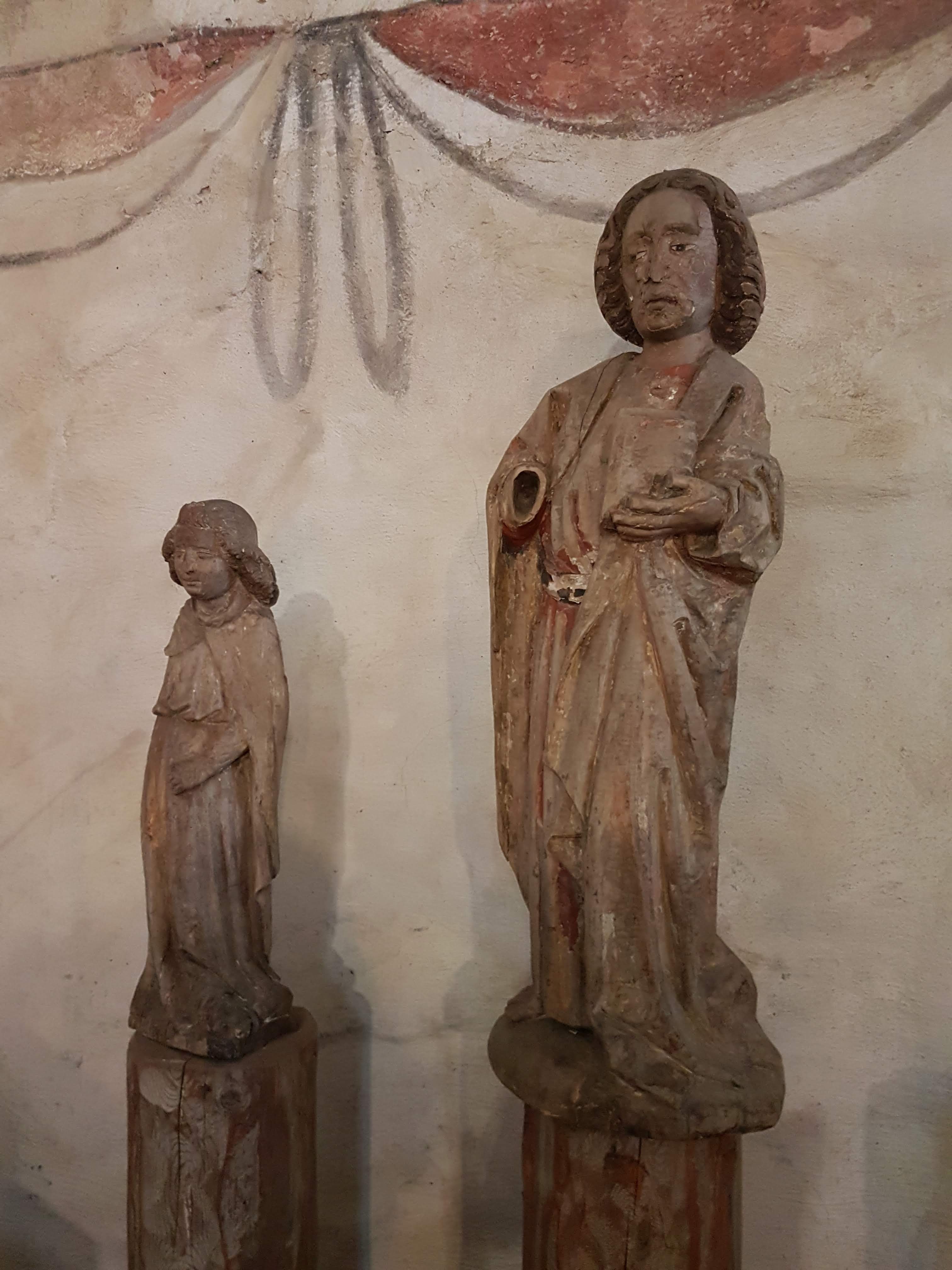
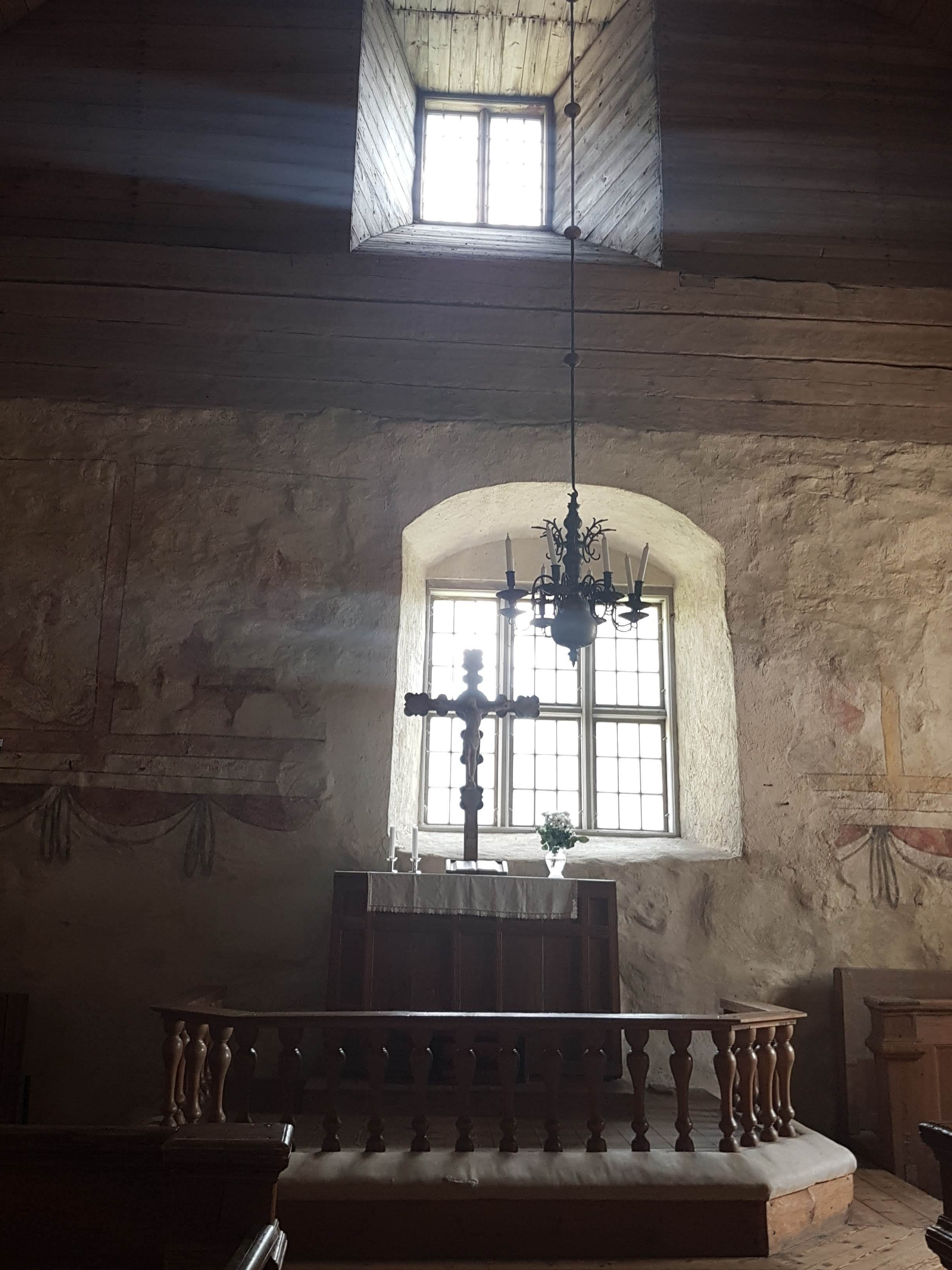
The church still houses several 15th century wooden sculptures, including a crucifix, which predate the stone church. The paintings on the church walls date from the 17th century and have been badly damaged — we were told this was largely caused by water running down the walls as the roof was being replaced in the 18th century renovations.

20180725_133235.jpg
Altar with 15th century wooden crucifix. As part of the 18th century renovations the church roof was raised by adding beams of wood between the stone walls and the new roof vaulting.

20180725_130620

[1] The “weapon room” was a (usually windowless) entrance space to the church. Its name refers to the habit of leaving weapons in the vestibule when entering the church, but Markus Hiekkanen in his work on Finnish stone churches emphasises the space’s religious significance: he sees it as a place of quieting down when entering the sacred space. The vestibule was also used in parts of seremonies, such as baptisms and weddings.

Literature:

Hiekkanen, Markus. Suomen Keskiajan Kivikirkot. Helsinki: Suomalaisen Kirjallisuuden Seura, 2007.

Bunny therapy

In between churches we stopped by a bunny cafe — an eccentricly charming mix of a cafe, man cave, print shop, and animal-assisted therapy centre. The cafe had a seperate room for “bunny therapy”, where customers could (for c. 20 minutes) enjoy the company of a group of laid-back, floppy-eared rabbits. The idea of animals bringing joy to man as companions (pets) is not a modern one, but goes back to the Middle Ages and beyond. Dogs and cats were long-time companion animals by the time of the medieval period, but many more species were kept as pets — these included exotic animals such as monkeys(!), and also (to my surprise) rabbits. In Medieval Pets (Boydell Press, 2012) Kathleen Walker-Meikle writes that rabbits were not only farmed for meat, but that nuns in particular kept rabbits as pets (p. 14), though these and other “frivolous and distracting creatures” kept in nunneries were condemned by some members of the clergy (p. 70).

1024px-tizian_018
Titian: The Madonna of the Rabbit (c. 1530). Admittedly not quite medieval, but more fitting illustration here than the murderous rabbits of medieval marginalia.

Tampere Cathedral

I confess to having been entirely ignorant of the artistic treasure-trove that is the Tampere Cathedral, featuring several frescoes and stained glass windows by the wonderful Finnish symbolist Hugo Simberg and a stunning altar painting by symbolist Magnus Enckell. Hugo Simberg is said to have drawn inspiration from medieval art — particularly his The Garden of Death has strong Danse Macabre -echoes.

1024px-kuoleman_puutarha_tampereen_tuomiokirkko
Hugo Simberg: The Garden of Death, fresco (1906)

20180725_160957
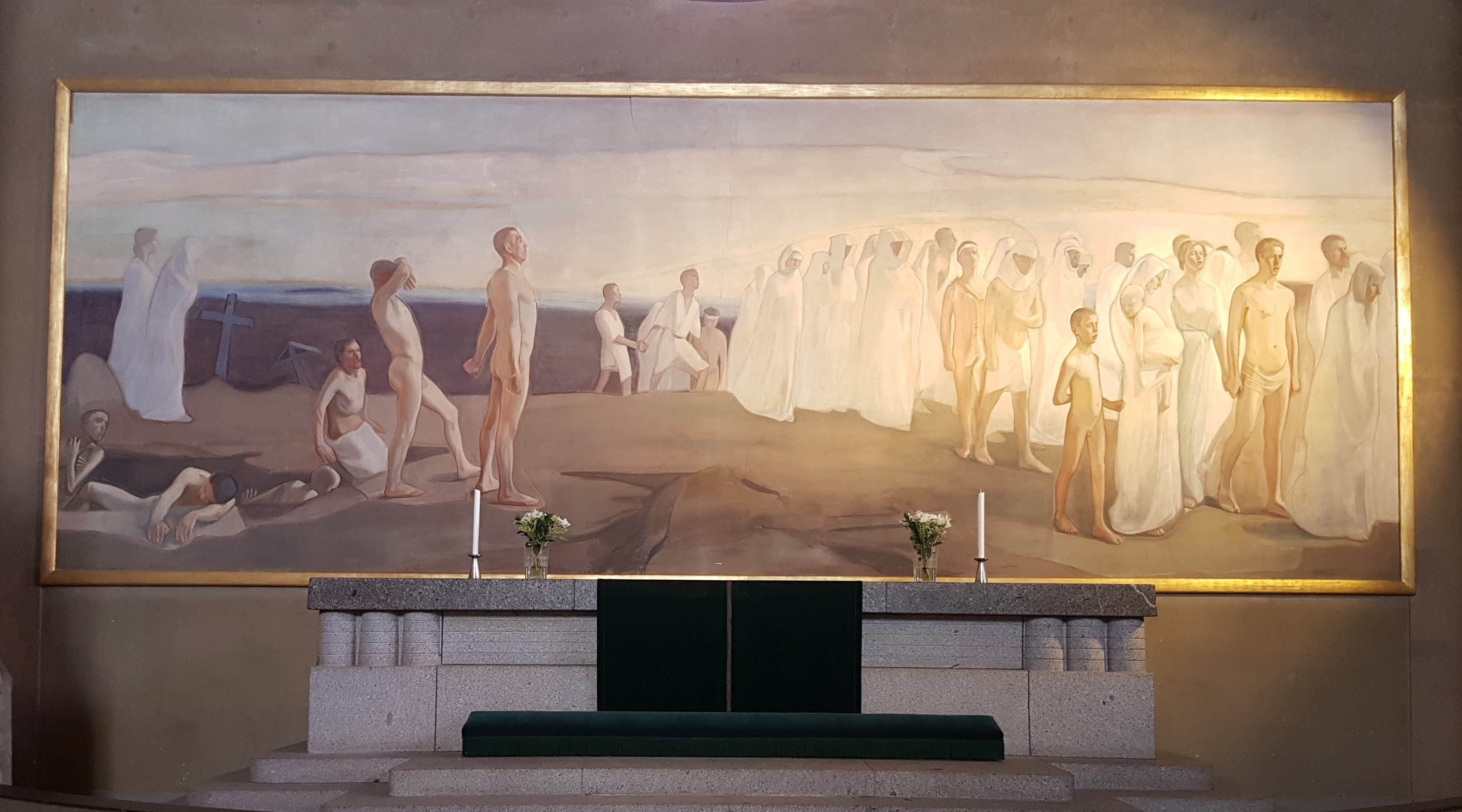
Magnus Enckell: Resurrection

Further reading: Simo Holopainen, Simbergin ja Enckellin teokset.

Grimstock and the Matthew Holmes Lute Books (pt. 1)

It’s that time of the year when I’m in sore need of a holiday but have made it impossible for myself to arrange one. Had I not procrastinated away the spring I would now not feel oblidged to work and study through the summer. It’s unfortunate, then, that lack of a summer vacation combined with a self-directed schedule is particularly fertile ground for procrastination of epic proportions. I can only be thankful that (to some extent) it has taken quite interesting forms. And that brings me to this blog post about the Matthew Holmes Manuscripts.

I’ll start off by making clear that I know next to nothing about music, and less about music history. I received a year or two of guitar instruction as a teenager, but in an attempt to be cool focused on rock riffs rather than theory, leaving adult and not-very-cool me without even so much as the ability to read musical notation with anything approaching fluency. What the lessons did gain me was a feeling that I ought to know how to play guitar, and moreover that I could do it if I really put my mind to it. That feeling has kept me returning to playing the guitar regularly (though just infrequently enough to prevent any significant progress).

This summer I had the pleasure of listening to some beautiful 17th century lute pieces played on guitar, and it struck me: why shouldn’t I learn lute compositions? The video game scores I’d practiced on for the past few years were as close to lute music as I had been able to find in modern music — I could as well move on to the real thing.

Some googling led me to Guitar Loothome to a wide array of classical guitar arrangements of early modern music written for the guitar, lute etc., courtesy of Eric Crouch. A quick dig through the site found me my first piece, rated Grade 04 by Crouch (the lowest difficulty rating I could find): a Grimstock tune by an anonymous composer. Short, simple, and blissfully repetitious, it has proved a fun exercise in preparation for what I hope to be my next challenge, one Nuremberg Fantasia (Grade 07, hmm).

The Grimstock composition adapted by Crouch is found in manuscript CUL Dd.9.33, one of the Mathew Holmes lute books. This manuscript is the third of four books of mostly lute tabulature. These books, copied at the turn of the 16th and 17th centuries, are our most important source for English lute music from the period.[1]

Grimstock

Grimstock is found on f. 81v of MS Dd.9.33 in between a jig dedicated to “Singer”[2] and a piece called The Shepherd. Grimstock is short, just twelve measures across three staves towards the top of the page. Above the tabulatures run marks indicating the rhythm of the tune.

Needless to say I’m lucky Crouch has turned the above into a more modern format:Grimstock2

(etc.) …which Musescore, in turn, can convert into tabulature:

Grimstock3

which I then, finally, can play. But now we’ve ventured quite far from the Holmes manuscript.[3]

The Holmes Grimstock is actually not a lute piece, but one of six bandora compositions in MS Dd.9.33 — actually, all pieces on f. 81v are for the bandora.

I had to google what a bandora was.

Google gave me this.

rita-repulsa

It’s time for bed. Next time: an actual bandora. Also, Nuremberg?

Notes:

[1] most important source: the four books comprise more than 300 folios (600 pages), totaling 650 items, making them the most extensive record of lute compositions in use in England at the time. University of Cambridge Digital Library: MS Dd.9.33.

[2] Jig to Singer: this is noted as being “probably dedicated to the actor John Singer (fl. 1583-1603)”. Dedications, it’s mentioned in the description of MS Dd.9.33, appear frequently in names of lute pieces, and dedicatees ranged from royalty to actors. Dedications immediately have me sitting up in my chair, since my autumn will be spent working with medieval English dedications and dedicatees in published works. It’s interesting so see actors amongst the dedicatees here, though since (lute) music was apparently used in theatre it’s not too surprising. Medieval, renaissance and early modern theatre is another topic I know practically nothing about… future blog post?

[3] Crouch makes mention of a certain resistance among modern-day lute players (lutenists! Word of the day) towards the idea of playing lute compositions with a modern classical guitar. It’s undoubtedly an anachronistic way of approaching the material, but it is a way of approaching it, and — as long as I lack a lute and any skills to play one — it strikes me as the most fun one, though as far as history (even of music) is concerned I’ll probably always be better at digging through archives than plucking guitar strings…

Literature!

I’ve now learned that there is such a thing as the Lute Society Journal. My university does not have reading rights to it, but thankfully, unlike many scientific publications, a single volume doesn’t cost an arm and a leg. Volume 5 includes the article “The Origins of the Cambridge Lute Manuscripts” by Ian Harwood, and volume 45 an article on Mathew Holmes and music at Oxford University by the same author.

See also: A Beginner’s Guide to the Renaissance Lute (Lute Society of America).